
National Reconciliation Week is approaching, and many workplaces are beginning to finalise their plans.
Last week, we reflected on the difference between intention and impact — and how Allyship asks us to stay open, even when feedback is uncomfortable.
Ultimately, these conversations don’t always stay theoretical. Instead, they frequently show up in the world around us.
A moment that many of us felt
During Anzac Day services this year, many Australians witnessed the booing during the Welcome and Acknowledgement of Country.
For many people, it was deeply confronting. Consequently, the incident raised important questions. Furthermore, it stirred strong emotions — including sadness, discomfort, and confusion.
Shortly after, Aunty Munya and I were invited onto ABC Radio with Waleed Aly to share our perspective. While the booing has been widely condemned, the deeper question undoubtedly remains:
What do we do next, as Allies?
Understanding the reaction
In that conversation, one specific point became very clear. Primarily, much of the public reaction comes from misunderstanding. For instance, we often hear comments like:
“I fought for this country. I don’t need to be welcomed to it.”
When someone holds that understanding, it naturally becomes easier to see why they may feel frustrated or even insulted. However, this is exactly where clarity matters. A Welcome to Country is not actually about welcoming someone to a modern nation-state. Rather, it is something much older. In fact, it serves as an invitation into a relationship.
A recent article by Tony Wright shared a story that has really stayed with us. An Aboriginal woman, Kitty Wallaby, responded to a claim of ownership not with an argument, but with quiet clarity:
“This is my country… but you are welcome to stay.”
Undoubtedly, there is something deeply powerful in those words. They present no confrontation. Moreover, there is absolutely no defensiveness. Ultimately, they offer just trut, and profound generosity.
What a Welcome really is
Furthermore, that story helps us understand something much deeper. A Welcome to Country is certainly not:
- a challenge to ownership
- a political statement
- or a gesture meant to exclude
It is:
- an invitation
- an act of respect
- a continuation of cultural practice that has existed for tens of thousands of years
As Aunty Munya frequently reminds us, a Welcome is not asking anything of you. Instead, it is a generous act — acting as a blessing for safe passage and a genuine extension of friendship.
Deepening understanding: Welcome vs Acknowledgement
If this moment has highlighted some confusion, you’re not alone. Many of the reactions we’re seeing come from a misunderstanding of what a Welcome to Country or an Acknowledgement of Country actually are — and why they matter.
At Evolve, we explored this in more depth last year, in response to very similar public conversations.
-
Welcome to Country: This is not a welcome to Australia as a nation-state. It is an invitation onto specific tribal lands — grounded in relationship, respect, and cultural protocol.
-
Acknowledgement of Country: This is different. It can be delivered by anyone, and is a way of recognising and respecting the traditional custodians of the land we live and work on.
Whether in the media or the Courts, it’s clear that many are still confused by these protocols. The key distinction? A Welcome is only ever performed by someone on their own traditional lands. This is why Uncle Ray Minniecon delivered an Acknowledgement – he was leading by example, showing us how to respect Traditional Owners of that Country.
Why this moment matters
When meaning is misunderstood, reactions can escalate.
Sometimes through frustration.
Sometimes through fear.
And sometimes, through something harder to sit with — including racism.
This is where many people — and many workplaces — feel stuck.
Because it is easier to:
- condemn
- disengage
- or stay silent
But none of those responses build understanding.
The real work of Allyship
Being “All In” means something different.
-
It means staying in the conversation — even when it’s uncomfortable.
-
It means not leaving this emotional and relational work to First Nations people to carry alone.
-
It means being willing to engage with people who are confused, frustrated, or pushing back.
Because one of the most important questions we can ask right now is: Who is having that conversation?
If we don’t step into that space, something else fills it. And that’s where division grows.
Giving these moments oxygen — in the right way
There can be a fear that talking about moments like this will make things worse.
But avoiding them doesn’t help.
At Evolve, we often talk about creating spaces with:
No shame. No blame. No guilt.
That doesn’t mean avoiding difficult conversations.
It means approaching them in a way that keeps people open, rather than shutting them down.
It means using these moments not to divide — but to build bridges of understanding.
What this means for workplaces
For many organisations, this raises a practical question:
How do we support our people to navigate moments like this well?
Not perfectly.
But thoughtfully.
Because these conversations are already happening:
- in teams
- in leadership discussions
- in quiet one-on-one moments
And often, people don’t feel confident in what to say or do.
Creating space for the “Hard Yarns”
These are the kinds of conversations we refer to as “Hard Yarns.”
They are not easy.
But they are necessary.
And they are where real learning — and real progress — happens.
This is also why many organisations are choosing to create structured, supported spaces during National Reconciliation Week.
Spaces where people can:
- ask honest questions
- explore real-world scenarios
- build shared understanding
- and develop confidence to respond in practice
Moving forward, together
Reconciliation is not a single moment.
It is not one week.
It is built over time — through conversations, relationships, and a willingness to keep learning.
If this moment has raised questions for you or your team, you are not alone.
And you don’t have to navigate it alone.
Explore your options this National Reconciliation Week
We are supporting organisations in a number of ways this NRW:
- Individuals and small teams → Public webinar
- Larger organisations → Shared sessions
- Private delivery → Tailored sessions for your context
You can explore the different options click here. 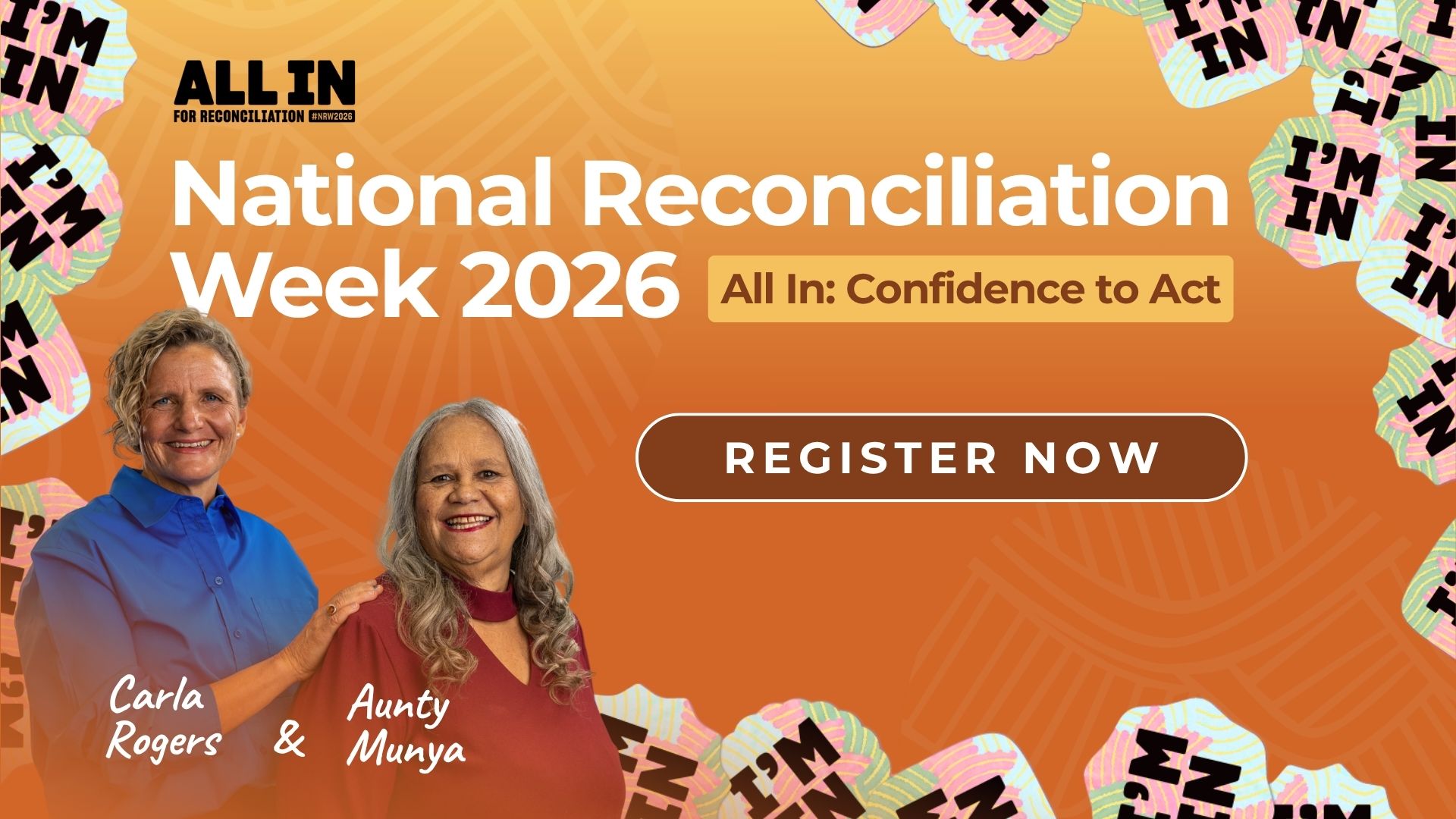
Because being “All In” is not about getting it right.

Recent Comments