
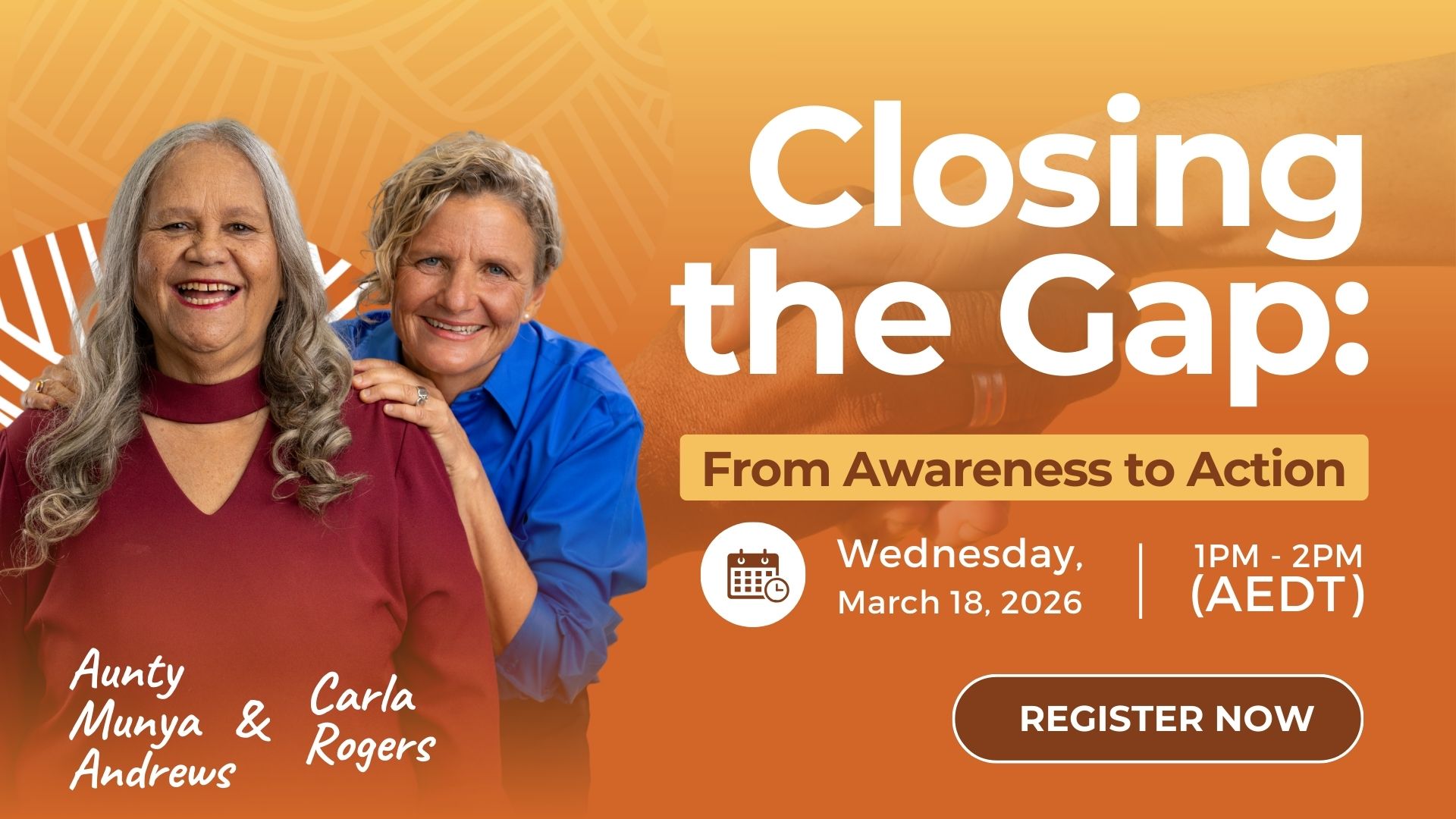
Carla Rogers is a community engagement specialist, facilitator, and program designer dedicated to Closing the Gap. After a Churchill Fellowship in 2001, she founded Evolve in 2005 and later joined forces with Aunty Munya. Blending Elder wisdom with world-class facilitation, she equips non-Indigenous Australians with the skills to become passionate and effective Allies to First Nations people.
👉 [Register Here: Closing the Gap Webinar | 18 March 2026]
What if Closing the Gap starts with me?
My Evolve office is fluid, changing depending on the day. Some mornings, you’ll find me writing from my tripod table under the open sky. Other times, I’m in a hammock, dogs nearby. When the weather turns cold or rainy, I retreat to my van. But most days, I settle into my indoor office for yarning circles and webinars.
No matter where I work, one thing remains true: I am at my best when I’m grounded and connected to Country. Whether it’s my feet touching the earth or the sky stretching above me, the privilege of working this way is something I never take for granted.
Tomorrow marks National Close the Gap Day, and a question keeps sitting with me: Have we, as Allies, got it all wrong?
As we reflect on the 19 Closing the Gap targets, the statistics tell a concerning story: only four are on track, while four others are actually worsening. So, what’s missing? Could it be that one of the biggest contributors to the gap is the gap in my own understanding as a non-Indigenous person?
What if the key to real change isn’t about “fixing” or “helping,” but about deepening our understanding?
Every day, I learn something new from First Nations peoples and their wisdom—truths that enrich my perspective. The more I understand, the more I connect, and the more I connect, the more I am inspired to act. But not from a place of charity or obligation. Instead, I act from a place of deep respect, mutual understanding, and shared purpose.
Take, for example, my understanding of Country. For First Nations peoples, Country is everything—it’s about family, health, and identity. As a non-Indigenous person, I am generously invited to share in this wisdom through the simple yet profound practice of Acknowledging Country.
My hunch is that if, as non-Indigenous peoples, we deepened our understanding of this cultural protocol and what Country truly means, it could radically transform how we approach Closing the Gap.
Uncle Tjilpi Bob Randall, a Yankunytjatjara elder and custodian of the concept of Kanyini, spoke deeply about the importance of connection—connection to Country, to each other, and to all living things. In his words:
“We are not alone. The whole purpose of our belief system is to relate well to every other living thing as family.”
Everything comes back to Country. When we talk about Closing the Gap, we must ask: Are we seeing the full picture? Are we recognizing that the solutions lie in deepening our understanding of First Nations wisdom and ways of being?
When we listen, when we acknowledge, when we learn—not just about the challenges First Nations peoples face, but also about their strength and wisdom—we begin to see that Closing the Gap isn’t about ‘fixing’ anything. It’s about closing the gap in our own understanding. From that place, we grow as Allies.
I’ll be exploring these questions and more in our National Closing the Gap Day Webinar tomorrow. I’d love for you to join the conversation.
National Closing the Gap Day Webinar
📅 Thursday 20 March | 1 – 2 p.m.
👉 Grab your ticket here.
What do you think? I’d love to hear your thoughts in the comment section below.
Join our community of Allies
Let’s show our Indigenous brothers and sisters that we are here for them, we value their Voices and we are committed to continuing the journey towards Reconciliation.

Recent Comments