

A simple practice in deep listening
How comfortable are you with silence?
Not sure?
Try this. Set a timer for 60 seconds. Sit still. Do nothing.
No phone. No multitasking. No filling the space.
Just silence.
What did you notice? How did it feel?
Ultimately, this simple practice brings us to Dadirri.
Dadirri is often described as inner, deep listening and quiet, still awareness. Furthermore, it asks us to slow down, listen deeply and make space before we rush to respond.
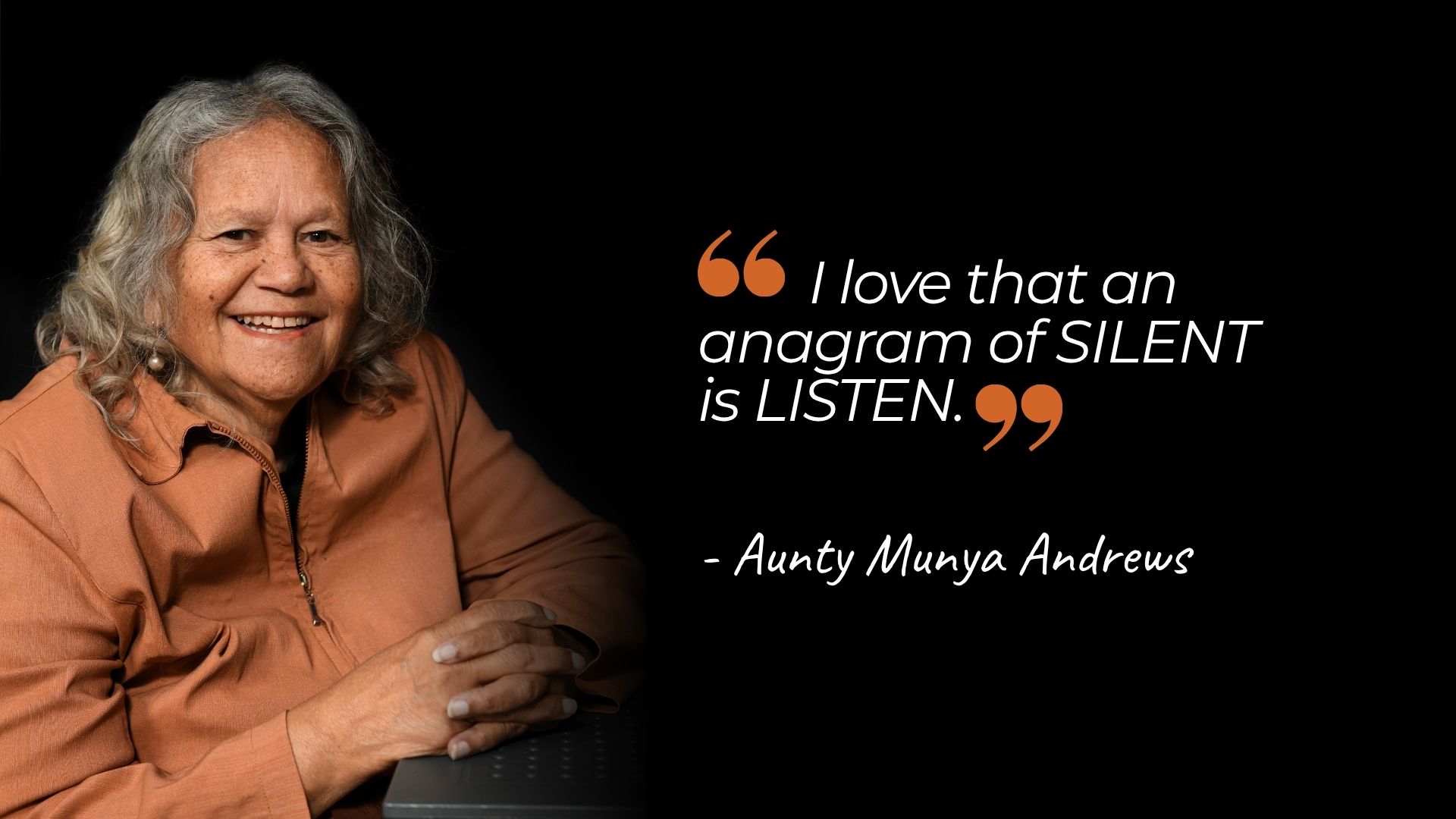
Aunty Munya often says: “I love that an anagram of SILENT is LISTEN.”
It is simple. yet it is powerful. After all, listening is not just the absence of speaking; rather, it is a practice.
Listening before acting
Aunty Miriam-Rose Ungunmerr-Baumann, who first shared the gift of Dadirri with Australia, describes Dadirri as inner, deep listening and quiet, still awareness.
She teaches that in Aboriginal ways of learning, listening comes first. Next is watching, followed by waiting, and finally acting. Undoubtedly, that order matters.
That order matters.
At Evolve, this connects deeply with our R3 approach: Reflect, Relate and Reconcile.
For instance, before we can Relate well, we need to Reflect. Similarly, before we can Reconcile in any meaningful way, we need to listen.
Listening. Waiting. Acting.
These are not passive things. They take discipline. Instead, they ask us to slow down enough to notice what is really happening – in ourselves, in others and in the spaces between us.
Silence is not empty
Carla often says the biggest tools she has are on the sides of her head – fabulous ears. Along with heart.
 However, she also admits that deep listening has not always come naturally.
In fact, in rushing to fill silence, she says, we can crowd everything else out. Consequently, that is why she has literally had Post-it notes on her desk saying: CLOSE YOUR MOUTH.
That is the polite version, of course. Apparently, listening is much harder when you are talking. It is funny because it is true.
In workplaces, community conversations and Reconciliation work, many of us rush to speak, solve, explain, defend or move on. As a result, silence can feel awkward, and stillness can feel unproductive.
Nevertheless, silence is not empty.
Silence can create room for truth. Additionally, it gives another person’s experience somewhere to land. Moreover, this quietness helps us notice what we would otherwise miss. That might be a feeling in the body, a discomfort, a question, a truth we have been avoiding, or simply the sound of our own breath.
Dadirri and Reconciliation
In Reconciliation work, deep listening is not a soft extra; instead, it is a responsibility. Furthermore, Dadirri reminds us that we do not always need to rush to the next answer. Sometimes we need to sit long enough to hear what is being asked of us.
Ultimately, Dadirri shapes the way we listen, learn and act. Therefore, it can help create stronger workplaces, safer conversations and more honest pathways towards Reconciliation.
So, can you sit in silence for 60 seconds?

It may sound simple. However, simple does not mean easy. And sometimes, 60 seconds is enough to remind us that listening is where the work begins.

Recent Comments